Sunday, 3 May 2009

The family

‘Family values are integral to our individual personalities. Family is undeniably crucial.’ (Swift).


I come from an unusual family. We wouldn’t be able to sleep at night if we had a penny extra change. I don’t know if you remember the Simpsons episode where Marge samples a grape and Lisa makes her pay for it? (It wasn’t on YouTube), but that’s like my entire family. I like to think that is normal but I don’t think it is. We all have very strong morals and the thought of stealing something, being rude or even getting drunk horrifies us.
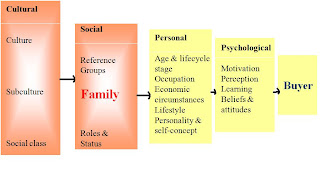
As we have studied, many things impact personal values. Experiences in life, religion, but most importantly, our primary socialisation, our family value systems. Family is the second thing on Kotler's diagram below, under socialisation.


I am lucky enough to have been raised with a traditional nuclear 2.5 kid’s kind of family, my brother who is even more principle-driven than me! This difference between us incurs as we have led different lives. Same parents, school, house, family, extended family, but there is still a difference. This is where life experience comes in. Following is a timeline of my life:


1989 Born
1990 Mandela Freed, earliest memory, very vague.
1995 Mum loses baby.
1996 Moved to Abu Dhabi, biggest experience of childhood, moved house, school, from family, whole life changed.
1997 Diana Dies in Car Crash, distinctly remember this. Scientists clone Dollie the sheep, Never realised the massive implication this would have on the world.
2000 Georgia dies in car crash. Broke my heart. Changed me into a completely new person. Made biggest impact on me in my whole life so far.
2001 9/11, sat in my living room watching in disbelief. I reach International championships in free skating and come out with gold for my level. Charlotte hit by a car and dies the same day as the competition; she was supposed to be watching and pulled out. I never skate again.
2003 Tension in Gulf States as Iraq war begins.
2004 Tsunami.
2005 Finish GCSE’s and start 6th form. Get into finals of Dubai Pop Idol, come 8th of 3000. Get to open for Kanye West.
2007 Finish A Levels. Spend 3 months in Australia. Work 7 months in a nursery, develop a disliking for children!
2008 Car crash whilst visiting Natalie in Red Hill, Break my coccyx (bottom of my spine), spend weeks in bed. Move to England for Uni. Start University a couple of months later. Nan dies 2 weeks into term.
2009 Obama elected as US president.


So yes, some of these as the same as my brother would have experienced but in terms of my hobbies, deaths of my friends and my car crash, these are all experiences very personal to me and no-one will ever know how I truly felt, no matter how much I try to explain, and how they impacted me.


The ‘family’ as a whole is a consumer. There are communal needs, usually bought by the mother, the intuitive one who will recognise that when there is a shortage of food or toilet roll, some needs to be bought. There cannot now be a generalisation made about families. There is not necessarily one breadwinner with 4 children. There may be ten children or one child, and both parents may work, or neither. This impacts their consumer behaviour of course.


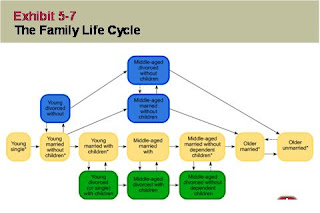
There is a family life cycle that the majority of people experience. Firstly there is the bachelor, who characteristically is young, characteristically is young, single, and not living at home. Secondly, there is the newly married, who are young with no children; and then there is the first stage of having a full nest, where the youngest child is under 6. Then there is the second stage of the full nest. This is when the youngest child is six or over. Last of the full nest is the third stage where the parents are older, married and living with dependent children. The first empty nest stage is those who are older, married, with no children living at home. The second stage is where the parents are older, married, retired with no children at home. The last 2 stages are those of the solitary survivor. The first is in labour force and the second is retired. Below is a visual explanation.


As you probably know, if your mum used fairy washing up liquid, the chances are you will. The purchase of household FMCG’s is passed through generations, i still buy the same table salt, cream crackers, cheese, butter and washing up liquid as my grandmother did. What does this mean for marketers? Well, if you manage to obtain a lifelong customer in one person, you may well end up with generations of them.


Thursday, 23 April 2009

Enterprise Week

Women in Business day.

The day was a fantastic experience in terms of business skills learnt but also life skills. A very large number of people attended, from all walks of life which added different experiences and opinions to generate a fascinating day. There were at least four successful business women who attended the event for more ideas. There were, of course students also. The range of topics covered by the women was extremely interesting and incredibly relevant. The opportunity presented itself as a fantastic way of meeting new people and networking.


The first speakers up were Penny Sloane and Kate Demain. They discussed impact management. Their target was to discuss how one can present oneself with confidence and credibility. They talked of ways to promote and enhance personal credibility through ‘impression and non verbal communication’. The workshop was great fun and a fantastic way of making us sit and talk to a group of people we didn’t know. It helped us to relax and chat comfortably. A very very interesting task we had to do involved us having to write down a word summing up the first impression we had of each of the people in our groups. Interestingly, the first impressions they had of me differed greatly to how I see myself and presume I project myself. I have always supposed I come across as friendly, open and confident. The general word that popped up was approachable... this, I feel I am but not what I go out of my way to project.


The women showed us a video discussing how quickly an interviewer decides whether or not they are going to hire someone. 3-5 seconds is all it takes to decide if a boss likes a prospective candidate or not! The situation of the video was a job interview involving three candidates with a completely different image. On a scale we could see how the impressions made during the initial stages of the interview were in fact the final decision and overall impression of that candidate. They told us, although it only takes between 3 and 5 seconds to make a first impression, it takes at least 12 further exposures to that person to alter the first impression.


The next speaker up was Susan Lock who talked about ‘powering up your presentations’. I, luckily, am not too apprehensive when it comes to public speaking. I find it thrilling rather than nerve racking. Before Susan started her presentation I was sure this wouldn’t be very useful to me, but really only beneficial for those scared of public speaking. How wrong I was! The information Susan provided us with was very constructive and positive for all future presentations I may have to make.


Susan Lock is the founder of HR and Training Consultancy, Key Consultants, based in Radnage, Buckinghamshire. With her years of experience, she delivered a fascinating presentation which changed how I have done presentations since. She went through each stage of a presentation, addressing the key information to include, in order to succeed and grasp the engagement and attention of the audience from the beginning. Susan used humour and anecdotes from the second she began, all of which related to her topics covered.

“A presentation is like a mini-skirt: it has to be short enough to get the attention, but long enough to cover the essentials."

Apparently, just 7% of a presentation’s effectiveness is the word content, 38% is voice projection and tone, and an astounding 55% come from the messages portrayed through body language and movement of the speaker. Susan gave us a format by which presentations should be addressed. In an ABCD format. A=Attention, B= Benefits c=credentials and D=Direction. Attention, gain it immediately. Benefits, what’s in it for the audience? Credentials, what makes the speaker qualified enough to be listened to? Direction, where is the topic going?


Both Susan and Penny tackled the importance of a professional first impression. Key elements of this image include being relaxed, this may be achieved through deep breaths; upright, position, the position of the head; movement of the speaker- avoid pacing as this can detract too much attention away from the presentation but do not stand completely still as it looks unnatural; and gesture making sure you make it relevant to you and the image you intend to portray. Finish the presentation in the position and area where you said positive points as the audience are more likely to adopt a positive image of the performance in comparison to standing in a spot where negatives issues were discussed.


The preceding speaker was Amanda Graham who discussed Creative thinking. This session gave us an insight into various methods of creative thinking techniques including: brainstorming, reverse brainstorming, SCAMPER: Substitute, Combine, Adapt, Modify/Magnify, and Put to other uses, Eliminate, Reverse/Rearrange, and random word processing. I found the reverse brain storming quite interesting and possibly relevant but the other methods discussed by Amanda seemed too abstract, confusing and disorganised for me and my way of thinking.


Caroline Kinsey was up next, who, as buck’s entrepreneur of the year, discussed Womenomics - The Rise and Rise of the Business Woman. Caroline discussed something which I felt was invaluable. So many women in the world of business feel under pressure to conform to masculine environment and thinking. She told us the only way to succeed is to embrace what it is that makes us different to men, and use it to our advantage. To embrace our femininity.


Caroline Kinsey shared her views and personal experience of building an award-winning PR agency, Cirkle PR and her new business, Trojan Training.


I found this talk so inspiring, especially Caroline’s emphasis on staff well being. It showed that the staff are at the centre of her business because at the end of the day, if the staff are happy more work is likely to be produced and to a much higher standard.


Caroline explained the key points involved in unlocking a successful business, these include recruitment, retention, training, culture, communication, feedback, reputation and finances.
A method of discovering one’s abilities is the Myers Briggs type indicator test, which I have previously discussed in my blog, as we were associated with a Simpsons character to explain what the results meant. Karen Taylor and Ann Mullard talked to us about the test and how to improve areas of weakness and utilise our strengths. The Myers-Briggs test shows the differences in people by where they prefer to focus their attention, the way they prefer to take in information, the way they prefer to make decisions and the kind of lifestyle they adopt. It helps to explain why all individuals are interested in different things, why they are good at different kinds of work, why some find it hard to communicate with each other and how to use these differences constructively.


The apprentice challenge!
The main event I took part in was the Bucks apprentice challenge. This event was quite intense but great fun and invaluable experience. The team, named ‘The Dream Team’, earned £300 in total, which meant that each team member walked away with £50 profit. The team got through the first round, but, unfortunately, didn't make enough profit in the second round to get through to the final stage.


The first challenge involved selling donuts on a campus of Bucks New Uni and making as substantial a profit as possible. We were presented with £50 which we used to buy the donuts and any other utilities we needed.

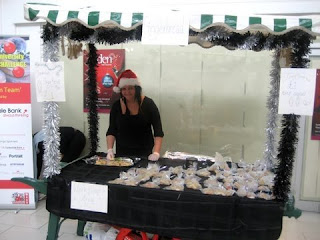
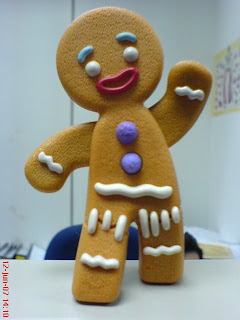
The second round involved setting up a market stall in the Eden Centre. We used the profit from the first round, and were given a further £200 to create a stall. We decided to sell hand decorated gingerbread men. This went down very well, but, regrettably, we over ordered on the gingerbread men, and we were unable to sell them all. This especially was a valuable lesson for me. Despite the stressful nature of the challenge, I learnt a great deal, had a fabulous time and made lots of friends. I’m already looking forward to entering next year!

Sunday, 19 April 2009

Gestalt & Perception

'All 'Things are not what they seem. The ability to work out what is really happening with a person is simple- not easy, but simple. It’s about matching what you see and hear to the environment in which it all happens and drawing possible conclusions. Most people, however, only see the things they think they are seeing. Perception.’ (Pease 2005).


Perception – ‘The process by which people translate sensory impressions into a coherent and unified view of the world around them. Though necessarily based on incomplete and unverified (or unreliable) information, perception is 'the reality' and guides human behaviour in general.’ (Business dictionary 2008).


Perception is the process of attaining awareness or understanding of sensory information. Perception is one of the oldest fields in psychology. The study of perception gave rise to the Gestalt school of psychology, which has a slight emphasis on holistic approach. There is research into perception of all the senses which originate from the thoughts of psychologists in the 1900’s. There is still very much a base of research into perception, for example, recent touch perception researchers Robles-De-La-Torre & Hayward (2001) found that kinaesthesia based ‘haptic’ perception strongly relies on the forces experienced during touch. The main school of thought into perception is the Gestalt school. It is well established and respected. In some scholarly communities, for example, cognitive psychology, Gestalt theories of perception are criticised for being ‘descriptive’ rather than ‘explanatory’ in nature. For this reason, they are viewed by some as redundant or uninformative. For example, Bruce, Green & Georgeson (1996) conclude the following regarding Gestalt theory's influence on the study of visual perception:


"The physiological theory of the Gestaltists has fallen by the wayside, leaving us with a set of descriptive principles, but without a model of perceptual processing. Indeed, some of their "laws" of perceptual organisation today sound vague and inadequate. What is meant by a "good" or "simple" shape, for example?" (Bruce, Green & Georgeson 1996).


In other fields, such as perceptual psychology, Gestalt principles continue to be used and discussed today as a predictive model of human behaviour. Many of the principles that govern human visual perception today were first identified by the German ‘school’ of Gestalt psychology. As Dodwell (1995) has observed, ‘To perceive seems effortless. To understand perception is nevertheless a great challenge.’ (Dodwell 1995).
Ehrenfels (1890) was a key theorist in the Gestalt school. He claimed that many groups of stimuli acquire a pattern quality that is greater than the sum of their parts. A square, for example, ‘is more than a simple assembly of lines, it has ‘squareness’.’ (Ehrenfels 1890).

The Gestaltists believed that the first perceptual task when confronted with an object is to recognise it. To do this, we must perceive the figure as being distinct from its surroundings. A figure’s familiarity can help determine whether it’s perceived as a figure or shape. Even unfamiliar and meaningless ‘blobs’ can be perceived as recognisable objects.
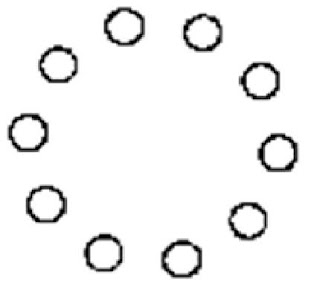
Gestalt psychologist Ehrenfels (1890) had a theory on ‘closure’; it was that elements appearing close together in space or time tend to be perceived together. One example is below.


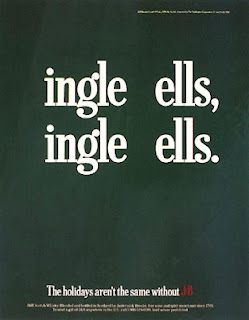
According to Ehrenfels, people will perceive this circle of dots to form a large circle as they are in such close proximity, even though there are many spaces between them. An auditory example would be the perception of a series of musical notes as a melody, because they occur soon after one another in time. Gestalt theorists believed that closed figures are perceived more easily than incomplete ones. So, we often supply missing information to close a figure and separate it from its background. By filling in the gaps, Ehrenfel believed that ‘men and women alike will see a circle’. (Ehrenfel 1890). This principle ‘explains why most of us have no trouble reading a neon sign, even if one or two of its letters are burned out.’ (Solomon 2006). An example of active involvement with the principle of Gestalt’s theory of closure is the J&B ‘ ingle ells’ advert which completely illustrates the use of the principle of closure, in which people participate in the advert by mentally filling in the gaps. We are solely capable of doing this by previous knowledge. This is an empiricist view.


Saturday, 18 April 2009

First Impressions

If you know me, you will most probably agree with the fact that the opinion you generate from the first impression I give you, is never the same opinion you will hold a year later. People tend to see me as very loud, confident and a little overwhelming but when you get to know me you find out I’m not always loud and am incredibly emotional. I work hard and am not the ‘party animal’ people think I will be, and I am loyal, which, for some reason, people don’t generally think I will be. According to Cooke (1973), people make an opinion about someone within 7 seconds of seeing them. It depends on clothes, hair colour, body shape, posture and the way in which one walks. This is all before someone has even spoken. We can all claim to be non –judgemental, but it’s a psychological fact that we, as human beings are. Why? Well Cooke discusses the Neanderthal man and how he would suss out enemy groups by the fur and clothes they wore, if they are plump (and therefore well fed and healthy) and the stride of his walk, with or without confidence. It’s incredible that it can be so relevant today.
The other reason behind the pre judgemental inclination of human beings is that of sniffing out a mate. Men look for women with large, ‘child bearing hips’ and breasts that are capable of carrying milk and supporting life and women look for fit, large men that can protect them and their offspring and support them with food and shelter. This is still quite relevant but with he changing society we live in, men are saturated with images of women that are thin

and considered beautiful so it is now more socially acceptable to date a thin woman than it would have been in say the forties. And women are also saturated with images of people like David Beckham who is considered to be sexy but is quite petit. So, where Cooke discusses an important first impression is weight, he talks of how men are attracted to larger women and when one is larger it is supposed to look like grandeur and wealth, this has seemingly flipped sides. There is now an epidemic of ‘fattism’ where people pre judge a ‘fat’ person so greatly, they dislike them immediately. This of course is terrible. After having taken the personality deciphering tests online, the fattism result discussed how 75% of the general public dislike overweight people!


A perfect example of misconstrued judgemental folks is that of Susan Boyle. If you don’t know of her, you will soon, I’m sure. Look at this video.


The woman suffers from a mild physical disability and so therefore society adjudicates her before she even sings. She is older looking and rather eccentric and therefore people look her as you can see in the video, as a waste of space. Simon Cowell, on top form as usual, is incredibly rude to her with his comments dripping in sarcasm. When she starts to sing, every single person in the place drops their jaw. It is a lesson for everyone; you truly cannot judge a book by its cover.

In the class, Maria came in without saying a word, she stood there in her colour coordinated, fashionable but conservative outfit and everybody’s initial reaction was that she was upper middle class, rich, and posh! When I wrote down what I thought of her, her upbringing and lifestyle she was used to (bear in mind this was from one look at a stranger!), I decided she was from somewhere like Kensington, rich family, private schooling and very quiet. Dear lord was I wrong! Maria is actually from Poland and is not what I thought she was at all! She’s very studious and quiet yes, but not the toffee nosed ‘ra’ girl I thought initially.

Another two brief examples of incorrect first impressions. Firstly, my first time in the university library. I walked into the toilets where a young girl, with a hijab (Arabic headdress) on. She was talking to a girl in a cubicle in Arabic. When I entered she said in Arabic something very racist and very insulting about English girls and how one of those w*ores had come in. I waited a moment and asked her, in Arabic, why she was studying in England if she didn’t like the English. I thought she was going to drop dead. And now she has to face me every day! Shame! Secondly, yesterday, I was in a takeaway restaurant (in Abu Dhabi), with my boyfriend Billy, where there was two women covered from head to toe in the black Arabic gear. Billy started questioning me about their outfits and then one of them turned around with a thick Tennessee accent and asked if we were English! Well I thought he was going to faint!! She was a converted Muslim who had married an Arab man and was now covered completely in black. It taught me a lesson, never talk about someone thinking they can’t understand you because the one time you’re saying something nasty, Murphy’s Law, they probably will speak better English than you!!


Thomas (2000) builds on Cooke’s (1973) theories. He theorises that 95% of all first impressions change within a month of knowing a person. This is why, he states, people feel such pressure in job interviews.

I suppose the experiences we have of absolute shock; humiliation and amazement where we are wrong teach us a valuable lesson. Don’t judge a book by its cover. Keep an open mind, as you might have a very nasty blow one day, you never know, it may even be a pleasant surprise.

Saturday, 4 April 2009

Values

This lesson was spent discussing personal values systems, why we have such different ones, and how marketers can exploit them. According to the buyer decision process chart (Kotler), consumers go through a very detailed, long process in deciding whether or not they will buy something. See below.


There are a range of depths of involvement implicated when consumers purchase a product. For example, fast moving consumer goods (FMCG’s), need very little decision making by the consumer in terms of comparing of prices etc. The sale is a habitual buy. In complete contrast with an FMCG, like a chocolate bar, is a house or car. Every step of the consumer decision model would be considered in depth and time would be taken to seek out cheaper, better quality alternatives. Basically, people are looking for the best buy for their money. So yes, the model is applicable for high involvement products. But is it really at all for FMCG’s? I decided to counter the hypothesis of 'it works for all purchases' and talk to students in the union shop as they bought chocolate, soft drinks and chewing gum. I asked them how much it was, were they regular purchasers, was there a cheaper alternative and did they feel they thought about the purchase, pre or post purchase? The results were unanimous. Ten people that were asked did not have a clue about the price, didn’t care if there were cheaper alternatives as the amount they were spending was so insignificant and bought the products out of habit. All of them agreed they didn’t think about what they were buying as they didn’t felt the need. I studied the behaviour of more people to see whether the price tags were consulted or whether people seemingly took the time to think before buying but no one seemed to perform as Kotler expected, by following all the stages of the buyer decision making process model. We can see how, as the type of purchase changes, the level of involvement by the customer changes.


As discussed by Barry Howcroft in his journal entitled 'Customer involvement and interaction in retail banking', all consumers asses high involvement products 'intensely'.
The class discussed the theorists Laurent & Kapferer (1985) who hypothesised that we can determine what is high involvement and low involvemtent products by a simple risk assessment of financial implications (house and car), time , performance, Ego, Physical and Social. (FTPEPS).


The class activity was to discuss the FTPEPS theory by Laurent and Kapferer and apply it to two types of people. Firstly a 21 year old and also a 46 year old. the products they hypothetically are going to buy are 1) a car, 2) a mobile phone and 3) underwear for their partner.


The responses were completely different by everybody. some people believed that younger men would be more embarassed and in contrast, some felt that younger would be more cocky and older more embarassed. the results far from correlated.

according to many theorists such as Kotler, Kerin and Hartley, the higher the thought involvement in a purchase = higher emotional involvement.

The definition of involvement according to Kerin (1989) - 'personal, social and economic significance of a purchase to the consumer'.

Why??


“If we believe our overall values drive our behaviour, then we should be concentrating on the important, underlying motives that drive consumers to make product or service choices rather than simply product attributes” (Ries & Trout 1982)

We then proceeded to talk about our personal value systems. Aaccording to Kahle (1983), the most important things to a person are :

1. Self Respect
2. Excitement
3. Being Well Respected
4. Self-fulfilment
5. Sense of accomplishment
6. Warm relationship with others
7. Security
8. Fun & enjoyment
9. Sense of belonging

The class prioritised these in the order they felt suited them personally. the results were shocking. the majority of english people put fun and enjoyment at the top of their list, with things such as self respect very far down. my list, along with the polish students was practically inverted. perhaps this is due to the secondary socialisation which occurs in England.. but perhaps it is due to primary socialisation too?


ØHigh involvement think-feel-do e.g. cars, computer equipment
ØLow involvement think-do-feel e.g. canned spaghetti

ØExperiential/impulse feel-do-think e.g. chocolates, crisps
ØBehavioural influence do-think-feel e.g. clothes


Wednesday, 25 February 2009

Apu. aka Franki...


'Mr. Simpson, pay for your purchases and get out...and come again'
Mr. Simpson, pay for your purchases and get out...and come again

We had to do a test fro Ruth to help with the personality module we were doing in class. With this test, we were assigned a personality type. These types were associated with a Simpson’s character. I came out as Apu! You know the Indian guy who runs the Kwik-E-Mart, with EIGHT children?! I suppose he’s not that bad... he’s funny and quite nice... (I think).

With this work we had to take a simplified Myers-Briggs test to discover what type of personality we have. My letter configuration is ENFJ. Only 2.8% of the population is the same as me. My supposed strengths are that I am a “warm and sociable” person who is “keenly in tune with others feelings and perspectives”. My weaknesses are that my “well defined value systems can make them inflexible in some areas”. this is scarily true. Seriously, seriously true. I’ve noticed since coming to England especially, that I am quite rigid with my morals and no matter how much someone will justify something to me, if I feel it is incessantly wring, I won’t budge.
After having completed this simplified version, I tried the full length Myers-Briggs type indicator. This produced the same configuration and went into much further detail regarding the weaknesses associated with my personality.

Thursday, 22 January 2009

RUTH. The Chav.


We began this lesson with an experiment where we had to group a page of shapes of a variety of colours, numbers and shapes into as many groups as was possible. It was amazing how many ways there was of doing this, for example, blue stars, stars, blue shapes would just be 3 ways for one shape. The possibilities were endless. This, was segmentation. When one considers the absolute immense number of citizens in the United Kingdom alone, the possibilities of segmentation are VAST. We discussed profiling in questionnaires and how profiler questions, such as age, newspaper read, ethnic group, gender were there to simply look at new ways of segmenting the population and ways of targeting them as a business.


The model of buyer behaviour by Kotler shows perception is a psychological influence on the consumer. Everything is based on perception. That is the beauty of human nature, the fact that everything we see will not be seen the same by anyone else in the world. It is an individual and personal concept and for marketers to try and target this, they must begin to understand the many populatory groups. Years ago, products served a purpose, for example the original car, it was £500, came on one colour and drove from a to b. People were satisfied with this as it satisfied their needs. There was a market monopoly and people thought nothing of not having a choice, it was only the privileged that had a car in the first place. Nowadays, cars are bought for certain purposes, such as racing cars, dune bashing and mountaineering.


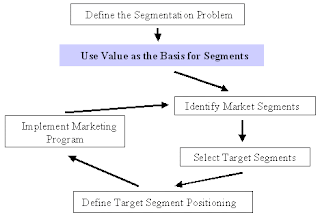
A type of marketing which uses this concept is STP marketing. In this, the company looks at Segmenting, Targeting and Positioning. See diagram above.


Segmentation can also be known as cluster analysis. The term cluster analysis (primarily used by Tryon, 1939) encompasses a number of different algorithms and methods for grouping objects of similar kind into respective categories.


So why do we bother to segment? Segmentation is a personalised approach which induces the possibility of a consumer purchasing the product that they supposedly 'need'. It's very effective which is why companies have such a large marketing budget. They reap the benefits at the end. There is a criteria of segmentation (there's no point in doing it if it doesn't work!) it is that it needs to be effective, identifiable, profitable, accessible and actionable.


You're probably wondering how I came to the conclusion that Ruth is a Chav? Well after being produced with receipts and being told to create a word picture out of them, my group was given a long receipt with ready meals, chocolates and a lot of convenience style goods. We decided this was because it was a chav mother with millions of children living on the dole. Apparently we were wrong. It was Ruth's!! So now we know how you perceive something can be be completely and utterly wrong... or was it?!!! x